
House Bill 8114: the proposed ban on e-wallet payments for online gambling
Short answer — House Bill No. 8114, filed in the House of Representatives on 26 February 2026 by Rep. Christopherson "Coco" M. Yap of Southern Leyte's 2nd District, would make it unlawful to fund, reload or cash out any online gambling through e-wallets, e-money, bank transfers, payment gateways, QR payments or similar channels, even for licensed operators. Players who try to pay would face 1 to 5 years in prison and/or a fine of ₱200,000 to ₱5,000,000. It is a bill, not a law: as of 22 October 2026 we could not confirm from a public House page that it has passed any stage beyond filing.
The bill matters to anyone in the Philippines who plays online, because nearly every top-up and withdrawal today runs through exactly the channels it names. This article reads the filed text section by section, places it next to what the Bangko Sentral ng Pilipinas (BSP) has already done and proposed, and works through what would change for a player, in pesos and in days.
What does House Bill 8114 actually say?
The filed text of HB 8114 carries a House receiving stamp of February 26, 2026, 12:42 pm, Twentieth Congress, First Regular Session. Its short title is the "Online Gambling Payment Channel Prohibition Act of 2026". The key provisions, in the bill's own order:
- Section 2, policy. The State would cut off "electronic payment rails" used to fund online gambling "regardless of whether such gambling activity is claimed to be licensed, authorized, or regulated".
- Section 3, definitions. An "Electronic Payment Channel" includes e-money, mobile wallets, online banking transfers, InstaPay/PESONet-type transfers, payment gateways, merchant acquiring, card-not-present payments, QR payments and stored value facilities. A covered transaction is anything that "funds, stakes, reloads, buys credits for, cashes out from, settles, or otherwise monetizes" online gambling.
- Section 4, general prohibition. "Notwithstanding any license, accreditation, permit, or authority", no person may use, and no payment service provider (PSP) may process, such a transaction.
- Section 5, exceptions. Only refunds of erroneous or unauthorised debits (if they do not enable more play), chargebacks, court- or AMLC-ordered transfers, and other narrow cases defined later in implementing rules.
- Section 6, prohibited acts. These cover PSPs that process payments, any person who initiates or attempts a payment, operators and agents that receive funds, and PSPs that disguise merchant codes.
- Sections 7 to 9, enforcement. PSPs must screen merchants, monitor and block transactions and report to the BSP; the AMLC keeps its freeze and bank-inquiry powers, which still go through the courts.
The explanatory note gives the author's reason: online gambling is "always just one click away", and cutting payments "at the source" is presented as preventive and "easy to enforce".
Who would be penalised, and how much?
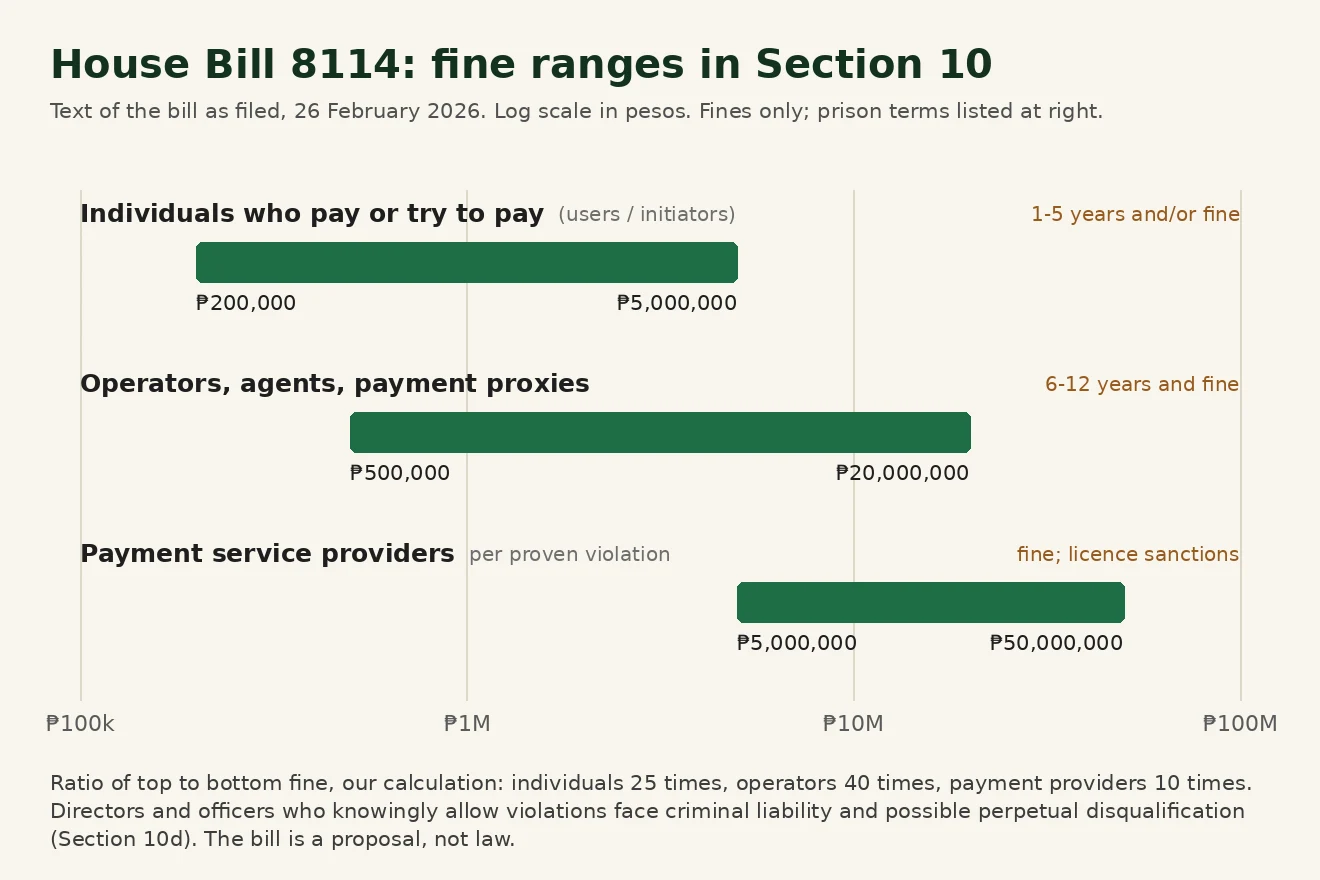
Section 10 sets three penalty bands. We copied them exactly and added the ratio between the highest and lowest fine, which is our calculation.
| Who | Prison | Fine | Top fine ÷ bottom fine |
|---|---|---|---|
| Individuals (users / initiators) | 1 to 5 years | ₱200,000 to ₱5,000,000 ("and/or") | 25× |
| Operators, agents, payment proxies | 6 to 12 years | ₱500,000 to ₱20,000,000 ("and") | 40× |
| Payment service providers / companies | None stated | ₱5,000,000 to ₱50,000,000 per proven violation | 10× |
| Responsible officers | Criminal liability | Possible perpetual disqualification from BSP-supervised institutions | — |
Two things in that table deserve attention. First, the individual player is a named offender: Section 6(b) makes it unlawful for "any person" to initiate or even attempt a covered payment. Second, the minimum individual fine, ₱200,000, is 200 times a ₱1,000 top-up and 1,000 times a ₱200 one, by our arithmetic. The penalty is designed to be far larger than any single transaction it targets.
How is this different from what the BSP has already done?
The bill does not arrive in a vacuum. The BSP has acted twice on the same problem, in different ways.
August 2025: links removed. BSP Memorandum M-2025-029 says the Monetary Board, in Resolution No. 805 dated 14 August 2025, approved suspending in-app gambling access, and instructs all BSP-supervised institutions to remove gambling links from their payment apps and websites "within 48 hours". It is a suspension "pending the issuance and implementation of the corresponding policy", and it targets links that redirect to gambling sites. It does not ban payments as such.
Draft circular: payments allowed, but capped. The BSP's exposure draft on online gambling payment services takes the opposite approach to the bill. It would let authorised PSPs carry gambling payments through a separate Online Gambling Transaction Account (OGTA), with limits:
- daily transfers into the OGTA of no more than 20% of the average daily balance of the owner's account;
- a payment window of no more than 6 hours a day, and a 24-hour cooling-off period after heavy use;
- facial biometric checks, one OGTA per person, and lending options switched off once an OGTA exists;
- PSPs needing prior BSP authority and at least ₱300,000,000 in capital.
Its eligibility list starts with the same rule PAGCOR applies: the account owner must be at least 21. The page we read is labelled a draft, with blank circular and resolution numbers, so its limits are proposals too.
| Question | BSP memo M-2025-029 | BSP draft circular | HB 8114 |
|---|---|---|---|
| Status | Issued, August 2025 | Exposure draft | Filed bill, 26 Feb 2026 |
| Gambling links in payment apps | Removed within 48 hours | Not allowed | Covered by the wider ban |
| Top-ups to licensed operators | Not addressed | Allowed via OGTA, capped | Unlawful by any electronic channel |
| Cash-outs | Not addressed | Allowed through the OGTA | Unlawful ("cashes out from") |
| Player penalty | None | None; limits and cooling-off | 1–5 years and/or ₱200,000–₱5,000,000 |
What would change for a player? Two worked examples
Under the BSP draft (our calculation). Suppose your e-wallet's average daily balance is ₱10,000. The 20% rule would cap transfers into your OGTA at ₱2,000 a day. At ₱25,000 it would be ₱5,000. You could move money only inside a window of at most 6 hours, which is a quarter of the day, and you would have set your own daily limit before the OGTA could even be activated.
Under HB 8114 as filed (our reading). The same ₱2,000 top-up would be unlawful through any electronic channel, and so would withdrawing winnings, because the definition includes cashing out. The bill's exceptions cover payment-provider refunds of erroneous debits and court-ordered transfers, but the text does not set out how balances already held at an operator would be returned once it takes effect. That is a gap a reader should notice; we do not guess how the implementing rules would fill it.
How fast would it apply? Our timeline
Section 16 says the Act takes effect 15 days after publication. Section 13 gives the BSP and AMLC 60 days from effectivity to issue implementing rules, and Section 12 gives PSPs 90 days from effectivity to block transactions, end merchant arrangements and certify compliance. Counting from a publication day "D", that is day D+15 for effectivity, D+75 for the rules and D+105 for full PSP compliance. Note the order: the PSP deadline falls 30 days after the rules are due, so the rules arrive before the blocking duty bites, if both deadlines are met.
What is still unconfirmed?
- Legislative status. The public House legislative-documents pages blocked our automated check, so committee referral, hearings and any substitute bill are unverified. A House bill also needs Senate approval and the President's signature to become law.
- Senate counterpart. We did not verify whether a matching Senate bill exists.
- Final BSP circular. We read the exposure draft; we did not confirm whether a final circular with the same limits has been issued.
- Effect on existing balances. Not addressed in the bill's text.
What should a player in the Philippines do now?
Nothing in HB 8114 is in force, so today's rules still apply. The PAGCOR responsible gaming page lists persons under 21 among those barred from all online gaming platforms and suggests checking a site at pagcorguarantee.ph before you play or pay. Two habits make sense whatever happens to the bill: keep only what you plan to play in a gaming account, and withdraw winnings promptly rather than leaving balances parked on a platform. If gambling is costing more than you planned, PAGCOR's self-exclusion portal and the National Problem Gambling Helpline listed on the same page are free to use.
Sources (checked 22 October 2026): House Bill No. 8114, filed text; BSP Memorandum M-2025-029; BSP exposure draft, Regulations on Online Gambling Payment Services; PAGCOR responsible gaming. Fine ratios, peso examples and the day count are our calculation; the reading of cash-outs and balances is our interpretation of the filed text, not legal advice.